




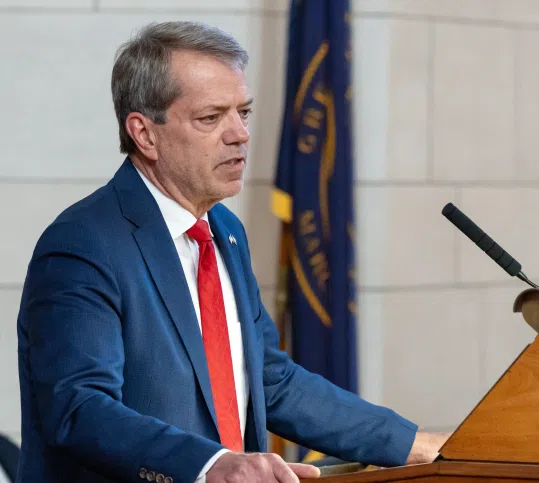
As lawmakers prepare to return for the final day of Nebraska’s 2026 legislative session, Gov. Jim Pillen vetoed five pieces of legislation approved by lawmakers and allowed one to pass into law without his signature.
When lawmakers reconvene at the State Capitol at 9 a.m. on Friday, April 17, they will have the chance to override each of Pillen’s vetoes. Each motion would require 30 votes in the 49-member, technically nonpartisan Unicameral to succeed.
Notably, all five vetoed bills were introduced by Democratic lawmakers. Three of the five are up for reelection.
Pillen issued individual letters explaining his reasoning for each decision Thursday. They are as follows:
VETO: LB 929
Pillen outlined numerous objections to LB 929 and derided the bill as “do-nothing legislation.”
The bill, sponsored by Sen. John Fredrickson of Omaha, clarifies the ability of managed care organizations (MCOs)—private insurers that administer Medicaid benefits under contract with the state—to cover deductibles and cost-sharing fees for Medicaid enrollees if they so choose.
Originally, the bill sought to broadly limit an array of out-of-pocket costs for Medicaid recipients in Nebraska, including caps on copays and restrictions on additional cost-sharing charges. But lawmakers removed most of those provisions during first-round debate earlier this month, leaving only the provision related to MCOs.
Fredrickson said MCOs in Nebraska began covering these charges in 2024 to ensure costs would not be a barrier to care. These costs to patients are often nominal, sometimes as low as $5. The final bill simply clarifies and cements an MCOs’ ability to continue doing so.
“Even though it has limited effect, LB 929 sends a terrible message,” said Pillen in his letter. “LB 929 invites overuse of our health system and more meddling in future legislative sessions. This creates an expectation that there will be no shared responsibility, which is a core tenant [sic] in ensuring that our benefits are hand-ups, not handouts.”
Lawmakers passed the bill 31-18.
VETO: LB 1029
Citing concerns about transparency and vulnerability to foreign adversaries, Pillen has vetoed LB 1029—a bill introduced by Sen. Danielle Conrad of Lincoln.
The bill would redefine terms relating to reportable funding from a foreign adversarial source for Nebraska colleges and universities. The governor argued that exempting employment contracts, salaries and wages from existing university reporting requirements would make Nebraska an “outlier and a soft target” for infiltration by foreign adversaries, namely, the People’s Republic of China and the Chinese Communist Party.
“I am deeply concerned that the full impact of these reporting exemptions was not adequately debated by the members of the Legislature,” Pillen said in his letter. “Transparency in state-supported institutions is a fundamental right of the public.”
Lawmakers passed the bill 29-20.
VETO: LB 839
Pillen called LB 839 “counterintuitive” in his veto letter.
The bill, sponsored by Sen. Victor Rountree of Bellevue, makes adjustments to biennial reporting requirements for cities to report to the Legislature’s Urban Affairs Committee on its efforts to address the availability of and incentives for affordable housing.
A particular section of the bill, dubbed the Nebraska Affordable Housing Act, would have barred the state’s Economic Development Department from approving financial assistance for construction of a multifamily rental unit project unless:
- At least 5% of the dwelling units included in the project will be accessible for persons with mobility impairments;
- At least two percent of the dwelling units included in the project will be accessible for persons with hearing or vision impairments.
In his veto letter, Pillen suggested LB839 would force builders to opt out of affordable housing programs and that “expensive new regulatory requirements” are the wrong approach to lowering housing costs for Nebraskans.
Lawmakers passed the bill 34-15.
VETO: LB 878
The governor vetoed LB 878, introduced by Sen. Dunixi Guereca of Omaha.
This measure creates a paid parental leave benefit for Nebraska state employees, providing up to six weeks (240 hours) of paid leave after the birth or adoption of a child.
In his veto letter, Pillen said this benefit is already available to the 12,000 state employees subject to collective bargaining agreements and members of the Nebraska Association of Public Employees—the state employees labor union. The governor suggested that employee benefits such as paid parental leave should be negotiated through the collective bargaining process rather than mandated in state law.
“I have directed the Department of Administrative Services to negotiate with the leaders of SLEBC, SCATA, and FOP to provide six weeks of paid maternity leave to all their members,” he said in his letter.
Lawmakers passed the bill 41-7.
VETO: LB 1256
Pillen’s first veto of the year, LB 1256 was sponsored by Sen. John Cavanaugh of Omaha.
The measure would have clarified that snow removal, ice control and flood response count as emergency services under state law.
In his letter, Pillen suggested that adding these duties to the list of emergency management functions would allow political subdivisions to “circumvent” an existing cap on property taxing authority, which includes an exception for declared emergencies.
Citing an assessment from the Department of Revenue, Pillen estimated the allowances would cost $40 million annually.
“I cannot in good conscience sign LB 1256 into law, which will increase property taxes, while we are in the middle of a property tax crisis,” said Pillen in his letter.
Lawmakers passed the bill 49-0.
TO BECOME LAW WITHOUT GOV. SIGNATURE: LB 1237
Calling the bill “well-intentioned,” Pillen said he will allow LB 1237 to become law without his signature.
Under the measure, the Nebraska State Patrol must implement security screening at the Capitol by January 1, 2027. Visitors will be screened for weapons and hazardous materials, including firearms, explosives, and certain knives. People with valid concealed carry permits and law enforcement will still be allowed to carry firearms under the law.
The plan also reduces public access points to a single main entrance, where screening will take place, and adds additional security staff to manage the process.
Pillen says he supports improving safety but raised concerns about limiting Second Amendment rights inside the building.
“Although LB1237 includes provisions which would not have been my preferred policy routes toward achieving our shared goal of a secure Capitol, I nevertheless respect the good faith and earnest efforts of the bill’s designers, as well as the overwhelming support it received on final passage by the Legislature, and will therefore allow it to become law,” he wrote.
Lawmakers passed the bill 45-4.
Each of Pillen’s veto letters is available below.
-

- LB929
-

- LB1237
-

- LB878
-

- LB839
-

- LB1029
-

- LB1256