




Inadequate child care costs Lancaster County an estimated $288.8 million annually in business output, according to a new report released Wednesday that documents the effects on working families, employers and the local economy.
The estimate includes direct economic losses and ripple effects through the economy. The report separately estimates $264.2 million in lost labor income, a reduction of 1,115 jobs in Lancaster County and $10.44 million in lost Nebraska income tax revenue.
The findings come from *Growing with Care: Child Care and Economic Opportunity in Lancaster County*, a First Five Nebraska report sponsored by the City of Lincoln, Lancaster County, the Lincoln Chamber of Commerce and Lincoln Littles.
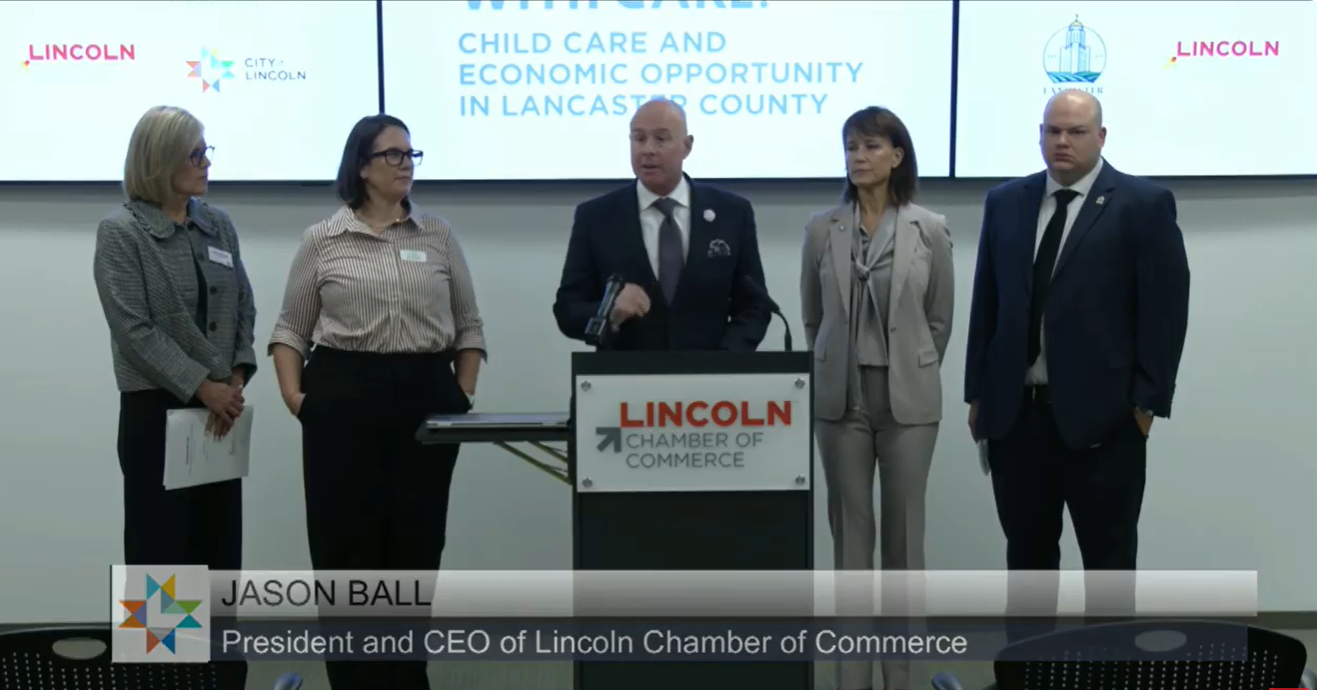
Representatives of the organizations discussed the findings during a joint news conference at the Chamber.
Lincoln Chamber of Commerce President and CEO Jason Ball said access to child care is an important part of the community’s workforce strategy, affecting both existing employees and Lincoln’s ability to attract workers.
Families Face High Costs and Limited Options
Parents pay an average of $296 a week for one child’s care, according to the report. That translates to $15,392 annually.
For parents with multiple children in care, the average bill rises to $533 a week, or $27,716 a year.
Nearly a third of parents who need child care — 32.5% — reported at least some difficulty finding it. Cost was the most frequently cited barrier.
The report identifies a shortage of 736 child care slots, or 4.5%, within a reasonable driving distance of children who potentially need care.
Families earning less than $100,000 annually were more than three times as likely as higher-income families to describe finding child care as very difficult: 14.3%, compared with 4.3%.
Among families using nonparental care, 16.5% of those earning less than $100,000 reported quitting or changing jobs because of child care, compared with 9.9% of higher-income families.
Lincoln Littles Executive Director Anne Brandt said the consequences extend beyond a family’s child care bill to its ability to work, cover basic needs and maintain financial stability.
Fewer Providers, Nearly Unchanged Capacity
Lancaster County had 329 child care programs serving young children in 2026, down from 442 in 2019 — a decline of 25.6%.
Total licensed capacity, however, increased slightly, from 15,226 to 15,331 over the same period.
The figures reflect a shift in the local child care market. The number of family child care homes fell 35.2%, while the number of child care centers declined 3.7%. Centers are licensed to serve more children, according to the report.
At the news conference, report author Dr. Katie Bass said home-based programs tend to offer lower-cost care. Their disappearance can further limit affordable options for families.
Ball said concentrating care among fewer providers also increases the disruption when a program closes.
Staff Turnover Adds Pressure
The report puts annual turnover in Lancaster County’s child care workforce at 39.5%. Just 32% of the current workforce has worked in the industry for at least six years.
Bass, director of policy research at Early Futures Partnership, said child care depends heavily on staffing, leaving providers exposed to rising labor and operating costs while parents struggle to afford tuition.
She said streamlining paperwork could help home-based providers stay in business while maintaining protections for children.
Local Leaders Point to Existing Investments
Mayor Leirion Gaylor Baird said the findings reinforce the importance of the city’s $2 million investment in federal and local funding toward early childhood education.
Lancaster County Commissioner Sean Flowerday highlighted the county’s Childcare Grant Program, which provides financial assistance for families and supports classroom improvements, learning materials, equipment and staff development.
Officials said the report will help guide future investments and policy decisions involving access, affordability and quality.
Read the full Growing with Care report here Growing-with-Care-Lincoln-Lancaster-Report